

Author: Andreea-Iulia Someșan
Original publication: Studia Universitatis Babeș-Bolyai Bioethica, vol. 59, nos. 1–2, 2014, pp. 127–130, Book Reviews section
Original language: Romanian
Note: The review published in the journal was written in Romanian. The present text is an English translation prepared for the English section of the personal blog Aletheia in Ethosland.
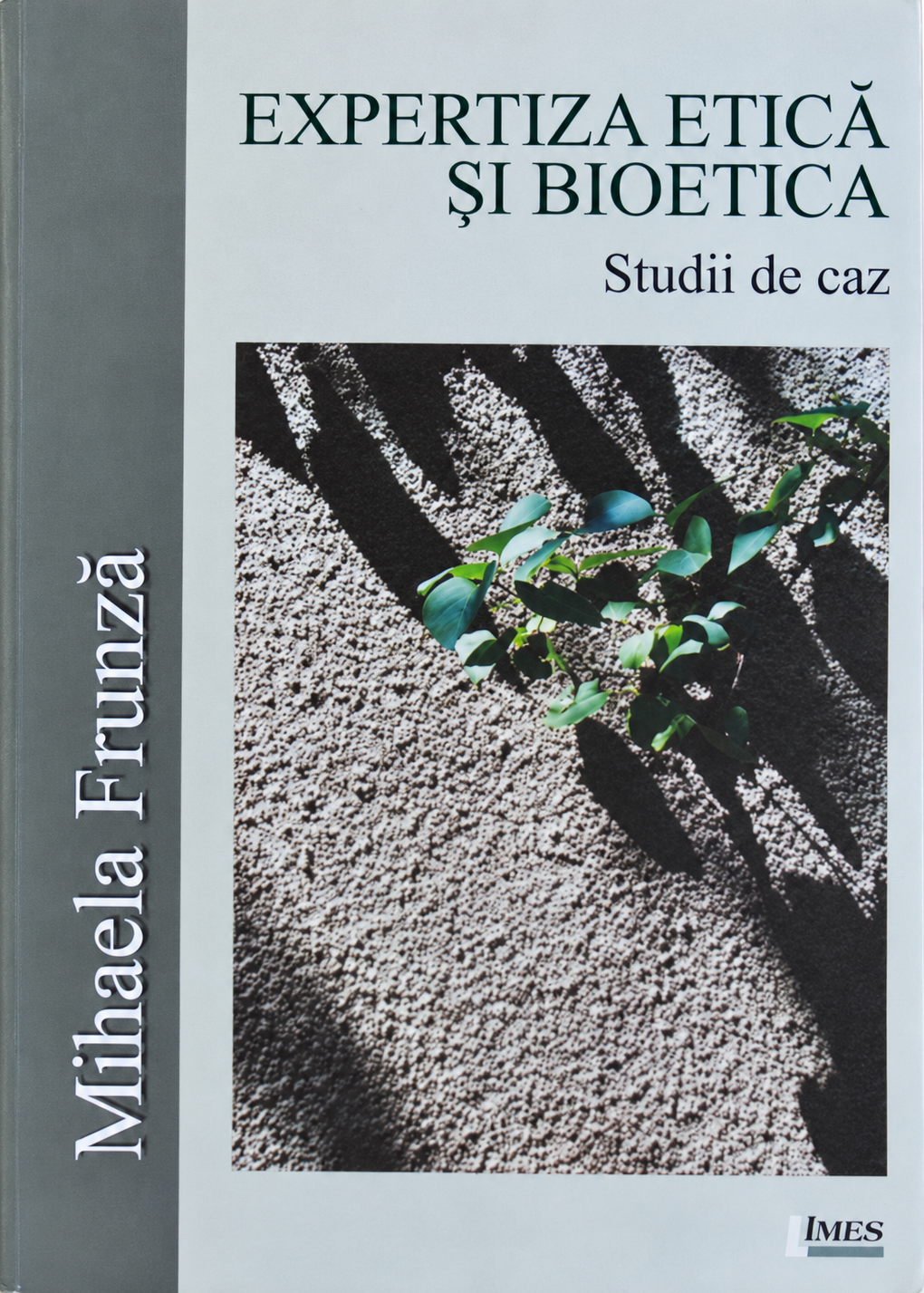
Original review title: “Mihaela Frunză, Expertiza etică și bioetica – studii de caz, Editura Limes, Cluj-Napoca, 2010, 250 p.”
The volume entitled Ethical and Bioethical Expertise: Case Studies was developed from research conducted by Mihaela Frunză, in her capacity as project coordinator, within the framework of a CNCSIS research grant and with the support of her collaborators.
Through the issues it addresses, the present work attempts to create a bridge between metaethics, spirituality and religion, and applied ethics. Its line of argument begins with a discussion of the philosopher’s role in medical ethical expertise and continues with a case-based approach to themes in applied ethics concerning the intrusion of new medical technologies into human life and their implications at the social level and in relation to religious thought. It then returns to the intersection of medicine and the widespread recognition of the role of spirituality and religiosity in the healing process. The work’s metaethical framework is completed by a final problematization of the confrontation between superstition and the secularization of the public sphere, an area in which the bioethicist may play a significant role in identifying a middle ground.
The topic to which the most extensive part of the volume, comprising four chapters, is devoted is transplantation. The aspects of interest include, on the one hand, the physician-donor-recipient-family relationship and the relationship between the community and the needs of those who require a transplant and, on the other hand, the medical difficulties that arise in the context of transplantation. For the recipient, the risks may be substantially increased if xenotransplantation is attempted, potentially reaching the limits of experimentation. However, in the case of transplantation from a living human donor, medical problems may also extend to the person who undertakes this voluntary act and who, regrettably, does not receive the same medical care and supervision as the recipient. Another issue that raises numerous questions concerns the implications of religiosity for the decision to become a donor. Thus, in the case of religious groups such as the “Jesus Christians,” whose doctrine is centered largely on the idea of organ donation, the autonomy of individuals making such a decision may seriously be called into question.
This is because, although emphasis is placed on the idea of altruistic donation, the presence of a strong discourse centered on this idea, together with the way donors are perceived within the religious community, could become a determining factor in decisions based on conformity. Religiosity may therefore make a legitimate and significant contribution to increasing the social acceptability of donation. However, exploiting this dimension of the human person, and perhaps not only this one, could hardly be considered legitimate as a means of increasing the percentage of donors.
Another theme addressed in this work concerns the irresponsible use of the advantages offered by contemporary medical technologies, which generates numerous problems and potential social dysfunctions. The case analyzed in this context is that of the Suleiman octuplets. Their mother, Ms. Nadya Suleiman, had previously undergone in vitro fertilization procedures that had already resulted in the birth of six children. For any ordinary family, caring for and educating such a large number of children would be challenging; in this case, however, the mother was also single and did not have stable employment. Moreover, she would not have had sufficient time to devote adequate attention to their needs and provide them with a good education.
The only way in which this mother could have fulfilled her parental responsibilities would have been with the support of the community, which would, of course, create a problem affecting the entire community. This leads us to ask to what extent she had the right to have all six remaining frozen embryos implanted. Here, however, we are not speaking only of her responsibility, but also of that of the physician who performed the procedure and who, having a clearer understanding of the possible consequences, could have refused the intervention and explained the advantages of the other available options more fully to the patient. Nevertheless, he stated that he had respected the wishes of the patient, who wanted neither to destroy the embryos nor to donate them to other families. The analysis of this case and of the implications of the irresponsible use of medical technologies leads us to ask to what extent, and by what means, society might prevent such uses when their consequences inevitably affect society itself.
The next case study focuses on a rather ambiguous topic because of the difficulty of conducting a factually grounded ethical debate on the matter: the role of intercessory prayer in the healing process. The numerous studies that have been conducted have failed to establish a definitive conclusion regarding its role in alleviating medical problems. Although certain studies, including retrospective ones, have appeared to confirm its benefits, others have seemed to cast doubt on them.
Moreover, since prayer is neither a medical treatment nor a medical procedure in itself, but involves a metaphysical element, namely the relationship with the divinity to whom these prayers are addressed, numerous questions arise concerning the legitimacy of such experimental studies. In this case, one may ask whether the research concerns merely the role of prayer or whether it constitutes a study of the power of divinity itself, or of its willingness to respond to the needs of those who are suffering. Such an approach would be entirely contrary to any religious worldview.
Numerous problems could also arise concerning the accuracy of such a study, since it would be genuinely difficult to ensure that those assigned to pray refrain from praying for members of the control group or to determine the extent to which the patients included in the study themselves pray or do not pray. It might then be assumed that an improvement in the recovery process or in the patient’s condition is attributable precisely to the participants’ suggestibility in relation to prayer, a factor that could perhaps contribute to the acceptance of such an experiment.
Another factor that increases the problematic character of this type of experiment concerns the potentially different religious orientations of the study participants and the people praying for them. It is difficult to imagine that someone would agree to have a person with a completely different understanding of the relationship with the divine pray for them or would accept that such prayer could have any medical effect.
This brief presentation may provide an overview of the issue, yet the chapter devoted to this debate draws attention to further difficulties that could arise from the institutionalization and public regulation of this association between medicine and religiosity. Nevertheless, one could not speak of a complete separation between the two. Rather, patients should be given the freedom to benefit from the religious and spiritual support that they consider most compatible with their own ways of thinking and that appropriately addresses their spiritual needs, providing reassurance that may facilitate the recovery process or improve the tolerability of illness. Regardless of the physician’s professional and personal views, if the patient has found a treatment that responds to their needs, the physician should provide all appropriate professional support so that, through the cooperation of medical and alternative methods, their common objective may be achieved to the greatest extent possible.
A theme connected with the preceding one, and the final theme of the present work, concerns the confrontation between a strongly secularized contemporary public sphere and the emergence of fears based on a literal reading of scriptural texts. One such case in the Romanian context concerning the so-called “biometric” passports. Their implementation is a part of a broader tendency toward the modernization of a society saturated by the presence of religious discourse, which therefore calls for the secularization of this type of discourse within the public sphere through the establishment of a clear boundary separating it from the private sphere.
Nevertheless, the manner in which religion is treated within the public sphere gives rise to a genuinely paradoxical situation. Although the contemporary context is said to be excessively permeated by religious superstitions, there is at the same time a powerful “discourse of the crisis of assuming Christian morality” (p. 211). The pages of this chapter therefore present a picture of rather intense disputes concerning the involvement of religion in the social life of the individual, as well as the numerous ethical arguments that make it increasingly difficult to establish the legitimate position of this discourse and of Christian values within contemporary Romanian society.
On one hand, limiting literal interpretations within Christianity appears to make a significant contribution to transcultural communication and the development of scientific work. On the other hand, the marginalization of religion within the public sphere might reveal the inability of traditional religious forms to respond to the value-related needs of contemporary human beings engaged in constructing a global ethical perspective through attempts to eliminate conflict among different religious understandings. In this context, the present work highlights the important role that bioethics centers might play as neutral spaces for dialogue in which a middle ground might be found between these two divergent perspectives on the public space.
The apparently insoluble problems discussed in the cases presented above necessarily lead to a clarification of how we understand the possibility of ethical expertise in the clinical field, a theme addressed at the beginning of the volume. The following question therefore arises: who might qualify as an expert in clinical ethics, and to what extent might ethical expertise and philosophical reflection complement one another?
The pages of this volume reveal divergent views on this issue, ranging from genuinely radical positions to those that seek to address the matter in more balanced terms. The first category includes views according to which it is impossible for anyone genuinely to be an expert in clinical ethics, as well as views that, by contrast, maintain that although every human being possesses the capacity for ethical discernment, philosophers alone are capable of providing authentic ethical expertise.
Among the more democratic approaches is the view that there are different categories of experts in bioethics, including philosophers. The type of expertise that philosophers might provide could include counseling aimed at resolving problematic cases encountered in current medical practice, as well as research into the integration of new biotechnologies into curative or preventive medicine, developments that have generated the need for independent ethics committees. The activity of the philosopher, together with that of the theologian, is particularly distinguished by the possibility of providing external oversight of medical practice, with a strong emphasis on its ethical dimension.
Through its approach to studies in applied ethics, Mihaela Frunză’s work is distinguished by its successful creation of a bridge between bioethical problems and their implications at the social level, as well as between the phenomenological dimension of ethical expertise and the metaethical problems associated with work in this field. Reading this volume thus provides a holistic view of the mechanisms of applied ethics and makes the interdisciplinary character of bioethics comprehensible or, more precisely, intelligible.
ANDREEA-IULIA SOMEȘAN
APA Reference
Someșan, A.-I. (2014). Mihaela Frunză, Expertiza etică și bioetica – studii de caz, Editura Limes, Cluj-Napoca, 2010, 250 p. [Book review]. Studia Universitatis Babeș-Bolyai Bioethica, 59(1–2), 127–130.

Leave a Reply